Every particle in a GPUParticles3D lives for exactly lifetime seconds. In a burst they are all born in the same frame, so they all go in the same frame too. Set lifetime_randomness on the ParticleProcessMaterial: at 0.7, each particle lives between 30% and 100% of the lifetime, and the burst thins out instead of popping off.
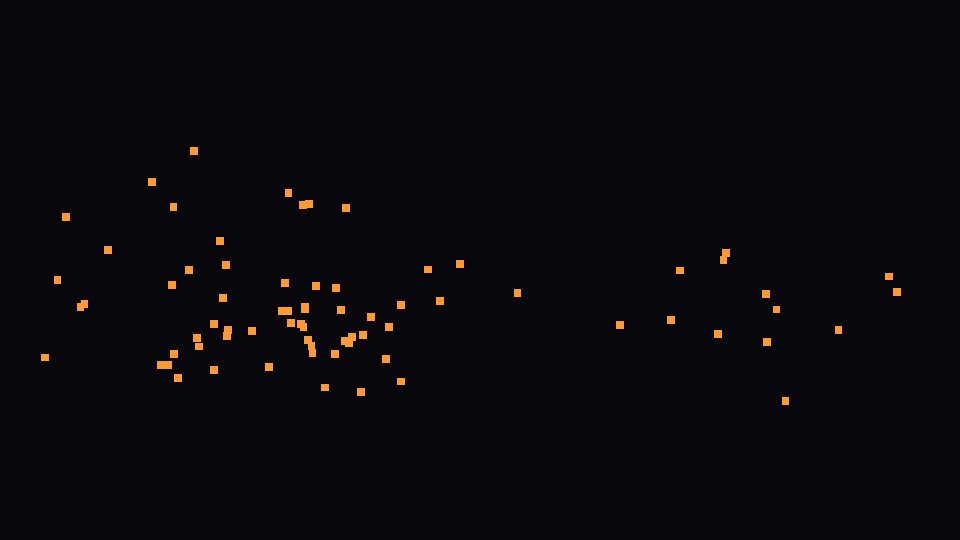
The code
Attach this to a GPUParticles3D for a burst of embers that thins out over time. Call restart() to play it again. The lifetime_randomness line is the fix.
extends GPUParticles3D
## A one-shot burst of embers that thins out over time instead of
## vanishing in a single frame. Call restart() to play it again.


func _ready() -> void:
	amount = 60
	lifetime = 1.6
	one_shot = true
	explosiveness = 1.0
	var m := ParticleProcessMaterial.new()
	m.lifetime_randomness = 0.7  # the fix: each one lives between 30% and 100% of lifetime
	m.direction = Vector3.UP
	m.spread = 70.0
	m.initial_velocity_min = 1.5
	m.initial_velocity_max = 3.5
	m.gravity = Vector3(0, -3, 0)
	m.damping_min = 1.0
	m.damping_max = 2.0
	process_material = m
	var mat := StandardMaterial3D.new()
	mat.shading_mode = BaseMaterial3D.SHADING_MODE_UNSHADED
	mat.billboard_mode = BaseMaterial3D.BILLBOARD_PARTICLES
	mat.albedo_color = Color(1.0, 0.6, 0.2)
	var q := QuadMesh.new()
	q.size = Vector2(0.08, 0.08)
	q.material = mat
	draw_pass_1 = q
	emitting = true
What we measured
We started a burst of 60 particles with a 1.6 second lifetime and counted the lit points on screen, every second pixel, at set times after the start. Two runs of each, after one warm-up run.
- Lifetime Randomness 0: 617 to 803 points from 0.3 to 1.56 seconds, then 0 at 1.71. The whole burst went in the same moment.
- Lifetime Randomness 0.7, the script: 646 to 711 points at 0.45 seconds, about the same as without it. Then 638 at 0.7, 379 to 435 at 1.0, 193 to 269 at 1.3, 53 to 69 at 1.55 and 0 at 1.7.
Nothing was missing at 0.45 seconds, just under 30% of the lifetime, and the last particles lived close to the full 1.6 seconds.
Lifetime is now the longest life
With Lifetime Randomness on, lifetime is how long the longest-lived particles last, not the average. If the burst now feels too short, raise the lifetime rather than lowering the randomness.
What to change
lifetime_randomness: how much shorter a life can be. 0.7 means down to 30% of the lifetime.amount,spreadand the velocities: the size and shape of the burst.
Fading each particle as it goes: particle color ramp not working. One burst for an explosion: explosion particles in one burst.
Tested in Godot 4.7 with the Compatibility renderer.
More how-tos: Fire, smoke and explosions
- Fire that turns to smoke in a cone
- Bright fire with dark smoke
- Smoke particles leave a hard line on the ground
- Particles drawing in the wrong order
- Explosion effect in one burst
- 3D debris particles not rotating
- Muzzle flash with a real light
- Glowing particles in Godot 4
- Glowing particles cast dark shadows
- Particles from the surface of a mesh, at runtime
- Fireworks without sub-emitters
- Fire or dust over a whole building