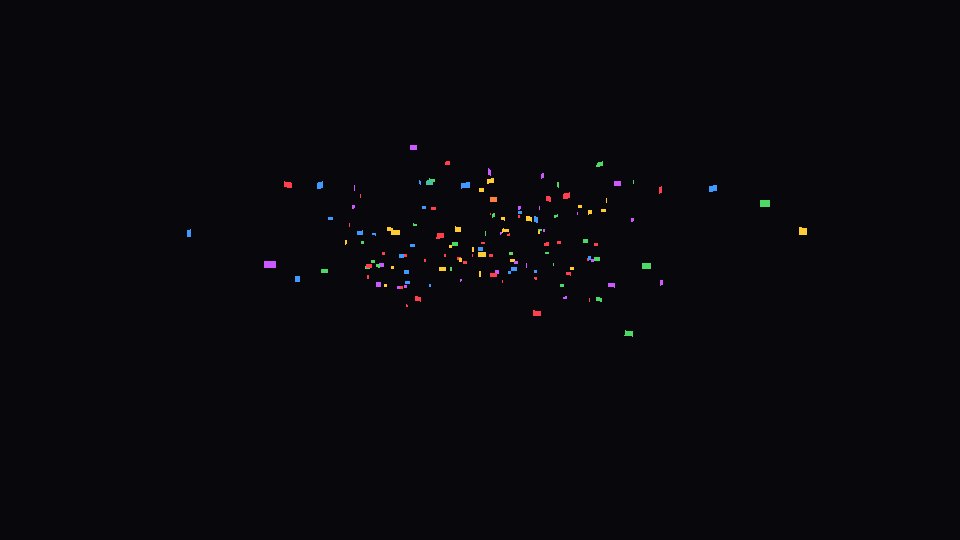
Give the process material a color_initial_ramp: each piece takes one random color from it when it is born. Set the gradient to Constant so it picks only your colors. Then turn on vertex_color_use_as_albedo in the material that draws the pieces: in our test, without it every lit point was white.
The code
Attach this to a GPUParticles3D on a win screen and call restart(). The vertex_color_use_as_albedo line is the fix, and the ramp sets the colors.
extends GPUParticles3D
## A confetti burst for a win screen: flat paper pieces in five colors that spin and
## drift down. Call restart() to play it again.


func _ready() -> void:
	amount = 150
	lifetime = 4.0
	one_shot = true
	explosiveness = 1.0
	var colors := Gradient.new()
	colors.offsets = PackedFloat32Array([0.0, 0.2, 0.4, 0.6, 0.8])
	colors.colors = PackedColorArray([Color(1, 0.25, 0.3), Color(1, 0.8, 0.2), Color(0.3, 0.85, 0.4), Color(0.25, 0.6, 1), Color(0.8, 0.35, 1)])
	colors.interpolation_mode = Gradient.GRADIENT_INTERPOLATE_CONSTANT  # one of the five, no colors in between
	var ramp := GradientTexture1D.new()
	ramp.gradient = colors
	var m := ParticleProcessMaterial.new()
	m.color_initial_ramp = ramp  # one random color per piece
	m.direction = Vector3.UP
	m.spread = 35.0
	m.initial_velocity_min = 5.0
	m.initial_velocity_max = 7.0
	m.gravity = Vector3(0, -3, 0)
	m.damping_min = 2.0  # air: the pieces lose speed, so the burst stays lower. Keep it under the gravity or they stop falling.
	m.damping_max = 2.0
	m.particle_flag_rotate_y = true  # flat pieces that turn as they fall
	m.angle_max = 360.0
	m.angular_velocity_min = -300.0
	m.angular_velocity_max = 300.0
	process_material = m
	var mat := StandardMaterial3D.new()
	mat.shading_mode = BaseMaterial3D.SHADING_MODE_UNSHADED
	mat.cull_mode = BaseMaterial3D.CULL_DISABLED  # paper has two sides
	mat.vertex_color_use_as_albedo = true  # the fix: without it every piece is white
	var q := QuadMesh.new()
	q.size = Vector2(0.12, 0.08)
	q.material = mat
	draw_pass_1 = q
What we measured
We used the same seed for every run, looked from the front with an orthographic camera, and sorted the lit pixels by color 1 second in. Two runs of each.
- The script: all five colors, 59 to 122 points each, 0 white, and only 3 points of any other color, at the edges of pieces.
- Vertex color as albedo off: 436 to 438 points, every one white.
- The script's damping of 2: the highest piece reached 4.20 to 4.42 m, and the average height was 2.98 to 2.99 m at 1 second and 0.73 to 0.82 m at 3 seconds.
- Damping 0: the highest piece reached 7.04 to 7.80 m, and the average height was 3.82 to 3.88 m at 1 second and still 2.17 to 2.23 m at 3 seconds.
Keep damping under the gravity
damping takes speed off every piece all the time, like air, so the burst stays lower. Keep it below the gravity, 2 against 3 here. With damping larger than the gravity, particles stop falling and hang in the air, as we found with snow particles not falling.
What to change
- The five colors in
colors.colors, and their share incolors.offsets. initial_velocity_min,initial_velocity_maxandspread: how high and wide the burst goes.angular_velocity_minandangular_velocity_max: how fast the pieces turn. Why they need Rotate Y: 3D particles not rotating.
Other ways vertex color matters: particle color ramp not working.
Tested in Godot 4.7 with the Compatibility renderer.